National Service Volunteer Registry (NSVR)
The NSVR is a program that helps young people learn about the importance of community service and how to make a difference in their communities.
Lorem ipsum dolor sit amet, consectetur adipiscing elit. Proin eget est sed ligula posuere sodales. Morbi a eros et lacus cursus sagittis. Proin sem sem, auctor a semper quis, maximus quis velit. Aenean aliquet bibendum velit at dictum.
Donec a lectus urna. Nullam eu sagittis risus. Duis eget tellus ultrices, egestas mauris in, imperdiet erat. Pellentesque mollis nisi lacus, a convallis odio ullamcorper vel. Donec nec pellentesque mauris. Nunc tincidunt sed eros sed pharetra. Etiam condimentum, justo ac vehicula imperdiet, magna orci porta enim, a scelerisque urna lorem sit amet metus. Nunc interdum quam sed sodales viverra. Pellentesque risus sapien, sollicitudin sed mattis non, vestibulum sit amet turpis.
Frequently Asked Questions
Find answers to common questions about our programmes.
About the National Service Registry
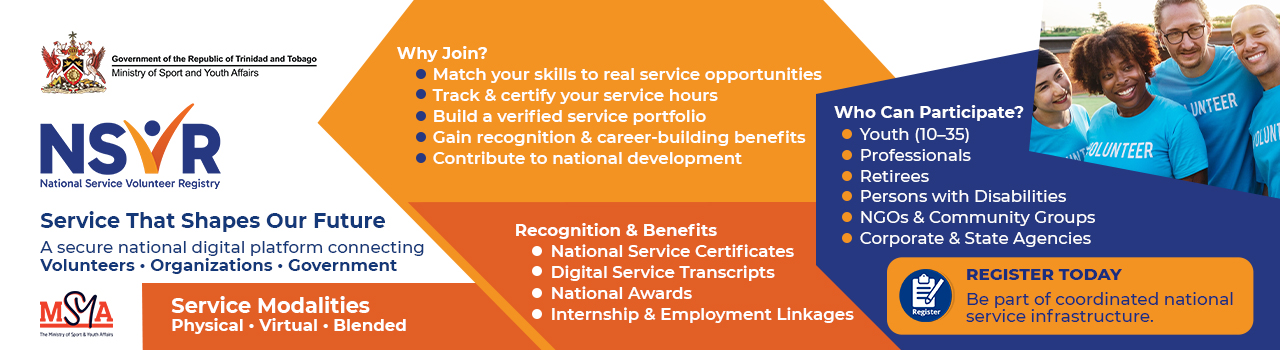
The National Service Volunteer Registry (NSVR) is a centralized, secure, digital platform that registers, coordinates, tracks, and recognizes volunteer and National Service participation across Trinidad and Tobago. It serves as the official national system of record for National Service.
The NSVR institutionalizes National Service by improving coordination, skills matching, and recognition of service and accountability. It supports youth development, employability, civic responsibility, digital transformation, and national resilience.
Yes. The NSVR aligns with national youth development, employment, digital transformation, civic engagement and disaster preparedness policies and forms part of the Government's long-term human capital and service delivery strategy.
The NSVR is open to all nationals of Trinidad and Tobago, including:
- Youth (10–35 years)
- Adults (36–59 years)
- Seniors and retirees
- Skilled professionals
- Persons with disabilities
- Faith-based and civic volunteers
Participation is voluntary unless required by a specific programme or institution. However, registration is mandatory for participation in any officially recognized National Service activity under the NSVR framework.
Service opportunities are offered across multiple sectors including:
- Education and Youth Development
- Sport and Physical Activity
- Community Development
- ICT and Digital Transformation
- Public Administration
- Environment and Sustainability
- Health Support (non-clinical)
- Culture, Arts and Heritage
The NSVR supports:
- Physical (on-site) service
- Virtual (remote) service
- Blended service (combination of physical and virtual)
Registration Process
Volunteers register online by:
- Creating an NSVR account
- Completing a personal profile
- Tagging skills and interests
- Selecting service preferences
- Completing required screening and induction steps
Yes. Assisted registration would be provided through youth centres, community hubs and designated support points for individuals with limited digital access.
Yes. Depending on the nature of the service, volunteers may be required to submit a Police Certificate of Character, complete relevant training, and agree to a code of conduct, especially for roles involving children, vulnerable persons or personal data.
Matching and Placements
The NSVR uses an algorithm-assisted matching system that considers skills and qualifications, availability, location, service preferences, and accessibility needs. Final placements are approved by host organizations and overseen by the NSVR Secretariat.
Yes. Volunteers can express preferences for sectors, locations, schedules and service types. Final placements are based on availability, suitability and organizational needs.
Host Organisations
Approved host organizations provide supervised service opportunities. Their responsibilities include:
- Volunteer orientation
- Supervision
- Verification of service hours or outputs
- Compliance with NSVR policies
Eligible host organizations include:
- Government Ministries and agencies
- Non-Governmental Organizations, Community Based Organizations, Faith Based Organizations
- Schools and educational institutions
- Sport organizations
- Community councils
- Corporate partners (CSR programmes)
Service Tracking and Recognition
Volunteers log service activity digitally through the NSVR platform. Supervisors verify submission and the Registry maintains secure records for accountability and reporting.
Yes. Virtual and blended service carry equal recognition, certification, and eligibility for incentives and awards.
Verification is enabled through:
- Secure digital certificates
- Registry confirmation
- QR code verification features
Incentives
Yes. Incentives may include:
- Priority access to training and skills programmes
- Mentorship opportunities
- National Service Awards
- Recognition ceremonies
- Subject to policy: stipends or reimbursements for specific service streams
Yes. The NSVR links service participation to training, internships, work-based learning, mentorship, and employment pathways to enhance workforce readiness.
Digital Platform and Data Protection
The platform supports:
- Volunteer and organization profiles
- Skills matching
- Service tracking
- Certification issuance
- Safeguarding compliance
- Performance dashboards
- Secure reporting and analytics
The NSVR complies with national data protection laws and uses:
- Encryption
- Role-based access controls
- Audit trails
- Secure hosting environments
- Oversight by a designated Data Protection Officer
Emergency Response
The Registry maintains a verified volunteer pool that can be rapidly mobilized to support disaster response, public health emergencies, and national priority initiatives in a coordinated manner.
Accessibility and Inclusion
Yes. The NSVR includes accessibility features, flexible service options, reasonable accommodations, and virtual service roles to ensure equitable participation.
Implementation
Implementation will occur in phases:
- Phase 1: Pilot and launch
- Phase 2: National expansion
- Phase 3: Integration and sustainability
This phased approach ensures stability, quality control, and long-term sustainability.
Monitoring and Impact
The NSVR includes a Monitoring, Evaluation and Reporting framework that produces dashboards, public reports, and performance indicators on participation, inclusion, and national outcomes.
Support and Information
Support is available through youth centres, designated help points, and NSVR online assistance channels.
Official updates and guidance will be provided through the Ministry of Sport and Youth Affairs website, public communication channels, and the NSVR digital platform.
Didn't find what you're looking for?